
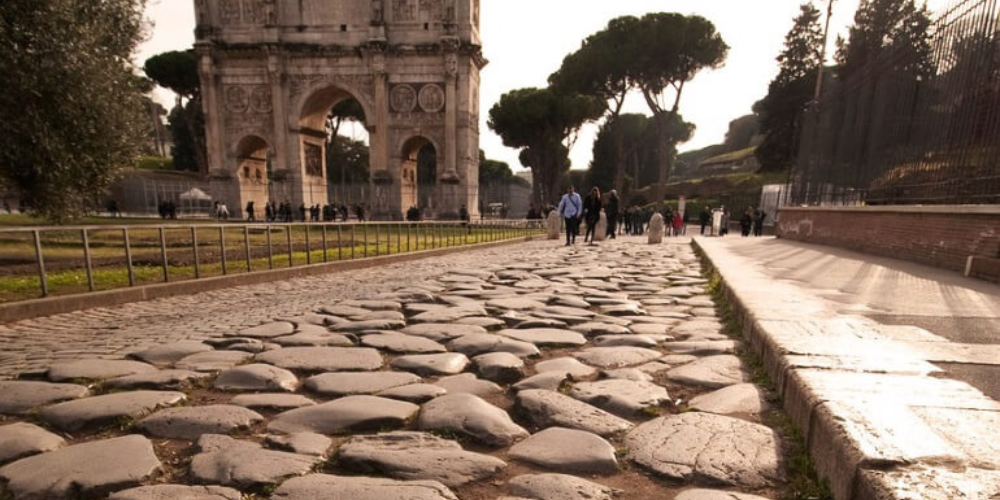
The pavers we use today are a culmination of human advancement. Paving has played a crucial role in human civilisation, evolving from simple stone paths to sophisticated, engineered surfaces that adorn modern landscapes. In this blog we will delve into the fascinating history, tracing the development of construction techniques and materials used for creating roads, walkways, and patios.
Early Beginnings: Natural Stone Pavers

The earliest pavers can be traced back to ancient civilizations. In Egypt, stones were used to create paths and roads more than 5,000 years ago for constructing roads that were crucial in building their great pyramids.
These natural stone pavers were basic but effective, providing stability and durability. In about 31 BC, The Romans later revolutionized paving by introducing tightly fitted cut stones set on a compacted aggregate base. This technique, known as the Roman road, was a significant advancement in paving technology. Roman roads were engineered for efficient travel and trade, with some still in existence today, showcasing their durability.
Middle Ages: Cobblestone Paving

The use of cobblestones, which are typically small, naturally rounded stones, dates back to ancient times. However, their widespread use for paving in Europe, especially in streets and courtyards, is particularly notable during the Middle Ages.
After the fall of the Roman Empire, there was a period where paving technology stagnated. However, the Middle Ages revived the use of cobblestones in Europe. The use of cobblestones for paving can be traced back to the 3rd and 4th centuries, predating the Roman Empire, and they continued to be used throughout history in various parts of the world, including Europe and Latin America.
In addition to streets, cobblestones were used in various architectural structures. During the 11th century, the Normans and Saxons built walls using cobblestones. Interestingly, the Finger Lakes Region of New York State, where glaciers had retreated, provided an abundance of small, rounded cobblestones that were heavily used in pre-Civil War architecture, especially for building walls.
Industrial Revolution: Concrete and Ashpalt

The Industrial Revolution in the 19th century marked a turning point in paving technology with significant advancements in the use of concrete and asphalt. This period saw the introduction of Portland cement, a hydraulic cement, which was a major innovation compared to the traditional lime-based cements. Portland cement, developed by heating limestone and clay, offered superior binding properties and revolutionized the construction industry.
The discovery of Portland cement led to the widespread use of concrete, enabling the construction of durable and resilient infrastructure like bridges, roads, tunnels, and buildings. Asphalt, a byproduct of the petroleum industry, became a popular material for road paving due to its smooth finish and ability to withstand heavy traffic. The use of asphalt in road construction signified a shift towards modernization and played a crucial role in shaping the transportation infrastructure of the 20th century
20th Century Innovations: Interlocking Concrete Pavers

The 20th century witnessed further innovation in paving with the development of interlocking concrete pavers. These pavers, developed in Europe after World War II, brought a new dimension to paving by being designed to interlock. This design allowed for a more even distribution of loads and accounted for thermal expansion and contraction, making them more durable and less prone to cracking than traditional concrete slabs.
The ease of installation and repair, along with their aesthetic appeal, made interlocking concrete pavers a popular choice for both residential and commercial applications. The paving industry also saw advancements in equipment and technology, such as the introduction of self-propelled asphalt pavers and slipform paving technology. These innovations enhanced the efficiency and quality of paving projects, paving the way for modern urban development and infrastructur
Modern Era: Sustainable and Artistic Pavers
The advancements in paving technology in the 21st century have been significantly influenced by a focus on sustainability and aesthetics. This shift in approach has led to the development of innovative paving solutions that are not only environmentally friendly but also visually appealing.
One of the key innovations in this field is permeable pavers. These pavers are designed to allow water to seep through them and replenish the groundwater, effectively addressing urban runoff issues. This technology has been advancing with the integration of smart features, such as the ability of walkways to monitor their own moisture levels and adjust their permeability accordingly.
Eco-friendly materials are increasingly being used in paving solutions. Recycled materials such as rubber and plastic are being utilized to create eco-friendly paving options. This approach not only reduces waste but also contributes positively to the environment. Open concrete grids and recycled asphalt and concrete are some examples of such sustainable paving solutions. Open grids made from concrete offer erosion protection and drainage while being durable enough for heavy vehicle traffic.
Porous asphalt and concrete are other eco-friendly options that provide excellent drainage and erosion control. Permeable pavers, particularly those made from recycled plastic, are among the most eco-friendly paving solutions. These pavers are durable, cost-effective, and require minimal maintenance.
In addition to sustainability, the aesthetic aspect of paving has also gained prominence. Modern paving solutions are not just functional but also contribute to the overall visual appeal of the area. This is evident in the use of decorative brickwork and environmentally friendly permeable pavements that enhance the aesthetics of streetscapes.
The choice of materials and designs has expanded to create unique and visually appealing streets, complementing urban design. Innovations in materials and the integration of landscaping, public art, and lighting in paving projects contribute to creating a cohesive and attractive urban environment.
A History of Precision
The history of paving, from its earliest forms to the sophisticated techniques and materials used today, is a story of continual evolution and innovation. This rich history underpins our work at Precision Paving, where we draw upon the cumulative knowledge passed down through generations to deliver outstanding paving solutions. Since our inception in the late 1980s by Neels Van Aswegen, Precision Paving has been a testament to the power of experience and expertise in the paving industry.
This journey of Precision Paving, rooted in the vast history of paving technology and enriched by our founder’s experience and expertise, reflects our deep commitment to upholding the highest standards in the paving industry. We believe in the importance of each step and stone in our path and continue to build on this legacy for the future.
Our founder Neels Van Aswegen, who initially garnered extensive experience in the civil engineering sector with Basil Read, recognized a market opportunity and ventured into paving as a subcontractor. His dedication, skill, and reliability quickly established a reputation for quality, paving the way for the growth of a successful business. This success was not just in terms of business growth but also in mentoring a team that would carry forward his legacy.
In 2015, Precision Paving was officially established by Neels’ grandsons, who stepped in to revitalize the business during a challenging time. They brought a renewed commitment to precision, quality, and excellence, honouring the legacy of their grandfather. This commitment is evident in our approach to every project we undertake, ensuring that each installation is executed with the utmost care and professionalism.
Today, Precision Paving stands as a respected name in the paving industry, having successfully completed over 500 installations across residential and commercial sectors. Our in-house teams, led by knowledgeable foremen, and collaborations with trusted subcontractors, allow us to meet the increasing demands of our clients efficiently. We pride ourselves on our customer satisfaction, timely project completion, and uncompromising quality, making us a preferred choice in the paving industry.